


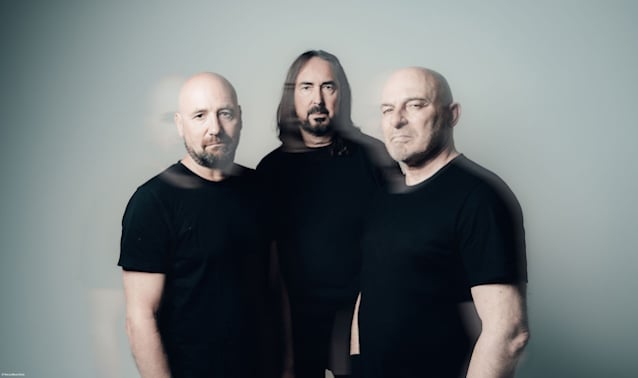
TOMMY VETTERLI Talks The Renewal Of CORONER Behind Stunning Comeback Album 'Dissonance Theory'
October 30, 2025By David E. Gehlke
It has been a whopping 32 years since CORONER released a studio album. "Grin" came at a time when the Swiss technical thrash masters weren't really in the mood to be technical thrash masters anymore. The album's chug-filled and experimental detours were a hard sell to fans and their record company in 1993, especially after four albums of some of the finest European thrash penned south of Germany. CORONER called it a day three years later, under the auspices that they would be relegated to the annals of metal history without receiving their proper due.
Then, of course, a funny thing happened along the way: A new generation of thrashers picked up on the brilliance of "R.I.P." , "Punishment For Decadence", "No More Color" and "Mental Vortex", subsequently reviving CORONER's status to the point where the lineup of bassist/vocalist Ron Broder (a.k.a. Ron Royce),guitarist Tommy Vetterli (a.k.a. Tommy T. Baron) and drummer Marky Edelmann (a.k.a. Marquis Marky) reformed in 2010. Fast-forward through a 2014 change in drummers (Diego Rapacchietti for Edelmann),multiple tours and festival engagements and at long last, CORONER has emerged with its long-awaited comeback studio platter, "Dissonance Theory".
It would have been easy for CORONER to take the bait and write another batch of technical metal workouts, but Vetterli had other ideas. "Dissonance Theory" is instead filled with rich, spacious chords and a new melodic framework that provides CORONER with an entirely new lease on life, one that now includes a crisp, yet bruising vocal performance from the long-buried-in-the-mix Broder. "Dissonance Theory" is arguably one of the finest and most satisfying comeback albums in recent memory. It was all the more reason for BLABBERMOUTH.NET to catch up with the guitar wizard Vetterli from his New Sound Studio in Switzerland.
Blabbermouth: Was there a specific moment where you said, "Okay, now's the time to start writing new CORONER material?"
Tommy: "It started as an idea. Through the years after the reunion, Marky said, 'I've played enough shows. I think it's time to stop.' Ron and I were like, 'No!' [Laughs] We were having so much fun and then we thought, 'Yeah, maybe we can play the old songs for the next ten years. We'll have to write new material, maybe.' The offers for a record contract came in, and we signed in 2015 [with Century Media Records], if I remember correctly. Then we wanted to start. Everybody expected the album around 2017 or 2018, but life happened. [Laughs] People died. My father, Ron's father, and then I went through a divorce, then there was Covid. I wasn't in the mood. When I look back at my schedule from the studio over the last ten years, I've produced 50 to 100 albums. That was a problem. Every time a band comes in, they stay for a month. When they leave, I have to re-learn my skills, and then I can't write in here [his studio]. I'm usually totally creative here, but not for this. I see work on every corner. I had to go to the Swiss mountains to write, then stuff started to happen."
Blabbermouth: Was there any weirdness in doing this without Marky?
Tommy: "No. It wasn't that different. The lyric part was totally different, but the music part was almost the same. I come up with almost finished songs. It was like that in the past. I'm kind of a dictator. [Laughs] Sometimes, one song should come from one mind. It works better most of the time."
Blabbermouth: The fact you're calling this a "renewal" is the thing that jumps out the most. It's not a continuation of "No More Color" or even "Grin" — it's like you're a new band. Can you share how that mindset came about?
Tommy: "Of course, it's all about what you expect. I thought about, 'Should it sound more like 'Grin'? 'Or, should it sound like the first albums?' Some people love 'Grin' and some people hate 'Grin', but I found out quickly that it doesn't make sense. I couldn't write 'No More Color' again. I'm a totally different person 35 years later. I just sat down and started writing, and that's what came out."
Blabbermouth: Is the catalog now out of your system, too? Have you played those songs enough?
Tommy: "Yeah. There are some fast, thrash parts on the new album, and of course, when I play live, I really like to play that stuff. It's fun. Maybe it's different now that we aren't technical for the sake of being technical. The emotional side of the music is more important. But if I feel, 'Oh, that could fit now…"
Blabbermouth: Let's be clear: You can still do the tech stuff easily.
Tommy: "Yeah, yeah. I still like it, but nowadays, there are so many great guitar players. On YouTube, it's like, 'What the fuck is he doing?' I don't understand it. [Laughs] But sometimes it goes in here and goes out there, and nothing stays in a lot of cases. That's the circus. It's not music."
Blabbermouth: One more thing about Marky not being around: You had someone from outside of the band, Kriscinda (Lee Everitt),help write lyrics for you. She's also doing your biography.
Tommy: "Even in the past, when Marky was doing the lyrics, he had help from a friend who is American. English is not our first language. It's really hard to write about something that is half-intelligent [in our native language]. In the beginning, everyone started to write the lyrics. Even Diego wrote lyrics for the new album. You can sing about slaying dragons or whatever, and a lot of bands do that; it's okay. It's entertainment. It doesn't fit our music. I wanted to have a narrative between the music and the lyrics. When the music goes crazy, the lyrics have to go with it. It wasn't enough for me. I contacted my friend, Dennis Russ, who wrote some lyrics as well. We discussed, and he started to help out, and we talked about the concept. I had the concept in the beginning, and he wrote two lyrics, but then I needed him as a co-producer. Time was running out. Marky came up with the idea, 'Hey, why don't you ask Kriscinda?' I think she wrote some stuff for [Edelmann's industrial outfit] TAR POND as well. It was like, 'Yeah, of course!' It was a no-brainer. What can be better than a real author writing stuff? She wasn't used to writing for music. That's a little bit of a different thing. She wrote something, then we're like, 'These words don't work here.' [Laughs] The meaning was perfect, but the sound of the word was not right. Dennis and she wrote a lot of WhatsApp messages throughout the night. We put piano notes on the demos to show her where the lyrics should go. That took a lot of time, but it was worth every minute."
Blabbermouth: CORONER has long had lyrics about the human psyche. It's only fitting that they've updated for 2025.
Tommy: "We spent a lot of time with Ron, telling him, 'You have to mean what you're saying. When you do it this way, it's authentic.' That was the most important thing. I think Ron sounds better than ever."
Blabbermouth: And he's mixed higher than ever. He was always a little lower in the mix before.
Tommy: "That's right. That's also because his vocals are better on this album."
Blabbermouth: Where did all these big, broad chords come from? Some of them, like on "Sacrificial Lamb", "Transparent Eye" and "Trinity" are fantastic.
Tommy: "The songs are a bit more song oriented. It was a natural thing with my job. Sometimes I produce pop music here, like, simple 'hits.' My taste changed a little bit over the years. Even in the past, we never wrote for a crowd or anything like that. We always wrote for ourselves. I think that's why the music is a bit weird sometimes. It works for us."
Blabbermouth: How much pushing did Diego need here? You pointed out what he did on "Symmetry" and it's very impressive.
Tommy: "I programmed a lot of stuff when I was in the house in the mountains, then he came in and we worked on it together. Sometimes I had to keep him down a little bit. I told him a few times, 'Hey, don't try to show off that you're the new drummer of CORONER. Just play for the song.' Sometimes he overdid things, but I let him do other things because he's great. I've worked with him for a long time. We did dozens of sessions in the studio. He was a session drummer I called for all different styles. He can play every style. Before we played together, we worked for years together. When we played together for the first time, it felt like we had been playing together for 20 years. It was a special connection. That was great. Because he could play everything, I had more opportunities when writing."
Blabbermouth: You had Jens (Bogren) mix and master the record. Was it a case of just needing fresh ears to take a listen?
Tommy: "I was supposed to mix the album. But when we got toward the end of the recording and were working on the keyboards, we asked, 'How loud should the keyboards be?' 'Oh no! Bring them back. We're now a symphonic metal band! 'I can't hear my guitars anymore.' I couldn't see the forest through the trees. Then I decided, 'Now is the moment to give it to somebody with fresh opinions.' That was the best decision. Most of the album is how we recorded it. My vision was to have a modern sound because I think today's productions sound better than those from the '80s or '90s. Maybe other people have a different opinion. From a musical or sound engineer's standpoint, the situation is much better nowadays. I wanted to have it with an old-school vibe. With Pro Tools, you can do one or two takes, then edit the hell out of it, or you can make six, seven or eight takes until the feel is right, then you're just recording like on a tape machine, which we did in the old days. We recorded more like that and kept the editing to a minimum. That makes a big difference."
Blabbermouth: Was it a bit like recording in the old days? Doing everything mostly live?
Tommy: "Back then, we did overdubs after we did the drums. We did the new album that way as well. I think we're not good enough to make a live recording [in the studio]. There are only a few bands, and maybe MESHUGGAH can do it. I think 99.5 percent of all bands are not good enough for this, unless it's a simple kind of music. Not metal on that level."
Blabbermouth: Can we revisit when you broke up the band nearly 30 years ago? Have your feelings toward that era changed in light of the fact that your reformation is going so well?
Tommy: "CORONER was the first band we all played in. We played in bands before, but we may have only done a few shows. After 11 years, it was just time to go further, to experiment, to play with other musicians. I always said I wanted to play or work with a singer who can sing actual melodies, but then I ended up in KREATOR. [Laughs] Most people don't marry the first person they meet. Marky was interested in techno music. That was a huge thing back then. It was just time. Ron didn't want to stop, I think. It was two against one."
Blabbermouth: Mille (Petrozza) once told me that it may have been hard for you to be in KREATOR because you're a band leader, and so is Mille.
Tommy: "Did he tell you that?"
Blabbermouth: Yes!
Tommy: [Laughs] "I think I can be a sideman. I'd actually like to be a sideman. Then I can step back a little bit. If a show is not that great, it's just 'Hey, I played my parts okay!' [Laughs] I'd like that, to share the pressure with someone."
Blabbermouth: Did you ever get any offers to join a bigger band on the level of, say, MEGADETH?
Tommy: "No, no. Actually, my friend, Teemu [Mäntysaari], is now in MEGADETH. He's awesome."
Blabbermouth: Would you have done something like that if asked?
Tommy: "Yeah. If I got the chance, I'd sure do it. Why not? But I stopped playing guitar for almost ten years. After KREATOR, I was more interested in producing. I concentrated on that. I was a little bit bored with playing the guitar for some reason."
Blabbermouth: I could see that. You once shared that you spent hours upon hours practicing.
Tommy: "I'm really bored fast with myself and my playing. That was part of the problem why I took so long as well. Maybe out of 30 riffs, one would make the album. It was like, 'Oh, I've heard that one before.' Or, 'This is boring.' I needed to have that special feeling. I can't explain it. It's a special feeling when you know you have something great."
Blabbermouth: It's interesting to hear you say that, since there's not much you can't play.
Tommy: "Yeah, everything bores me, even with other bands. I like a few new bands, but it's maybe because of my job. I listen to music all day."
Blabbermouth: Did you feel that way about other bands when you were coming up?
Tommy: "I wanted to be as good as other guitar players like Yngwie [J. Malmsteen]. I just loved playing guitar, and I loved practicing. That's not for everybody. I mean, there are great musicians. They're not good technically, but they write awesome songs. You have to be a nerd to sit down for hours and practice the same stuff."
Blabbermouth: How did you feel when this entirely new generation discovered CORONER? That had to feel nice.
Tommy: "It was crazy, and that's why we did the reunion in the first place. Seeing YouTube, young musicians playing our stuff. I was like, 'What the fuck? What's going on?' Even the first show in Switzerland. It was a club, and sometimes there are just normal disco parties with all these young hipsters there, like, 'Hey guys, Tonight is the metal show. It's the wrong day for you.' Then they were in the first row banging their heads off. It was like, 'Okay…this feels great. It's awesome."
Photo credit: Manuel Schütz


 Prev
Prev 